TaborBlog

“All things biblical” from the Hebrew Bible to Early Christianity in the Roman World and Beyond

The “Gabriel Stone” on Display: Some Revised Interpretations

Many of my regular blog readers know all about the so-called “Gabriel stone” and its intriguing references, as argued by Prof. Israel Knohl, to raising a corpse “after three days.” I have several blog posts dealing with this topic that you can access here: “Suffering Messiahs and Resurrection after Three Days.”

The stone itself is going on display in Jerusalem tomorrow at the Israel Museum:

JERUSALEM (AP) — An ancient limestone tablet covered with a mysterious Hebrew text that features the archangel Gabriel is at the center of a new exhibit in Jerusalem, even as scholars continue to argue about what it means.

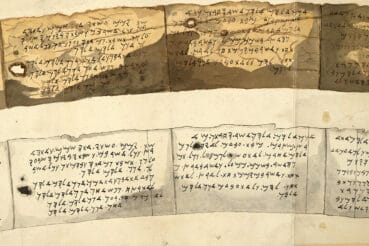
The so-called Gabriel Stone, a meter (three-foot)-tall tablet said to have been found 13 years ago on the banks of the Dead Sea, features 87 lines of an unknown prophetic text dated as early as the first century BC, at the time of the Second Jewish Temple.

Scholars see it as a portal into the religious ideas circulating in the Holy Land in the era when was Jesus was born. Its form is also unique — it is ink written on stone, not carved — and no other such religious text has been found in the region.

Curators at the Israel Museum, where the first exhibit dedicated to the stone is opening Wednesday, say it is the most important document found in the area since the discovery of the Dead Sea Scrolls.

You can read the rest of the AP story here.

What is not so well known is that Professor Knohl has changed his mind about the transliteration, and thus the translation, of the key line 80 in the text that he had previously argued talked about resurrection of the dead after three days:

By three days–live, I Gabriel command you, prince of princes, the dung of rocky crevices.”

In a paper given at a 2009 conference at Rice University on the Gabriel Stone, now published in the conference volume as, “The Apocalyptic Dimensions of the Gabriel Revelation in Their Historical Context,” Knohl says he was mistaken in his original reading.[1] Knohl still maintains that the text was “composed shortly after 4 B.C.E.” by “followers of the messianic leader Simon, who was
killed in Transjordan in 4 B.C.E.,” which is where the stone was probably found. He continues to see it as an example of what he calls “catastrophic messianism” where a slain Messiah gives a new/holy covenant to Israel. What he now doubts is that the text speaks of “making the dead live after three days.” Following the readings of Yardeni and Elizur he accepts as the translation for line 80:

In three days the sign will be (given). I am Gabriel

The critical word that Knohl once read as a verb, “to make live” (חאיה) now is read as the noun “sign” (האות). On the whole, however, his overall interpretation is the same and if he is correct the text continues to have great significance for our understanding of “messianism” among late 2nd Temple Jewish groups.

Though I greatly respect Knohl’s integrity in so freely changing his mind I am not convinced that this alternative reading is necessarily correct. Unfortunately the text is faded at this point, and even after subjecting it to a battery of scientific tests designed to enhance its clarity, it may be that we will never know with certainty how it should be read.

  1. In Hazon Gabriel: New Readings of the Gabriel Revelation, edited by Matthias Henze (Atlanta: Society of Biblical Literature, 2011): 36-60. See the SBL review of the volume here. []
Share

Tabor, Rollston, and Goodacre Weigh in on the Talpiot Tombs

Many thanks to Bible & Interpretation for posting the papers presented  last month at the Southeastern Regional Meeting of the Society of Biblical Literature and the American Schools of Oriental Research on the book,  The Jesus Discovery: The New Archaeological Find that Reveals the Birth of Christianity (New York: Simon & Schuster, 2012) and the entire question of the Talpiot tombs in general:

James D. Tabor, UNC Charlotte, “The Tombs at Talpiot: An Overview of The Jesus Discovery

Chris Rollston, George Washington University, “The Talpiyot Tombs: Some Sober Reflections on the Epigraphic Materials

Mark Goodacre, Duke University, “The Jesus Discovery? A Skeptic’s Perspective.”

These three presentations offer a fairly comprehensive overview of of the question of whether these tombs likely or likely not may be related to Jesus of Nazareth and his family. Please take a look and comment if you are so inclined on one or all of these papers.

Share

Bible History Daily Features TaborBlog Post on “Strange Ending of Mark”

And they went out and fled from the tomb, for trembling and astonishment had seized them, and they said nothing.

Most general Bible readers have the mistaken impression that Matthew, the opening book of the New Testament, must be our first and earliest Gospel, with Mark, Luke, and John following. The assumption is that this order of the gospels is a chronological one, when in fact it is a theological one. Scholars and historians are almost universally agreed that Mark is our earliest gospel–by several decades, and this insight turns out to have profound implications for our understanding of the “Jesus story” and how it was passed down to us in our New Testament gospel traditions.

To read more click here.


Share

“Conflicting Theology” Review of Paul and Jesus, Parts 1 & 2

It is difficult for one to imagine a version of Christianity pre-dating Paul with none of the core theological affirmations we find in the Apostles Creed.  Yet that is precisely what our evidence indicates.  The original apostles and followers of Jesus, led by James and assisted by Peter and John, continued to live as Jews, observing the Torah and worshipping in the Temple at Jerusalem, or in their local synagogues, while remembering and honoring Jesus as their martyred Teacher and Messiah.  They neither worshipped nor divinized Jesus as the Son of God, or as a Dying-and-Rising Savior, who died for the sins of humankind.  They practiced no ritual of baptism into Christ, nor did they celebrate a sacred meal equated with ‘eating the body and drinking the blood’ of Christ as a guarantee of eternal life.  Their message was wholly focused around their expectations that the kingdom of God had drawn near, as proclaimed by John the Baptizer and Jesus, and that very soon God would intervene in human history to bring about his righteous rule of peace and justice among all nations.  In the meantime both Jews and non-Jews were urged to repent of their sins, turn to God, and live righteously before him in expectation of his kingdom.

Sign at the Entrance of the Church of All Nations, Garden of Gethsemane

Thanks to Howard Pepper and his two part review of my new book, Paul and Jesus which you can read in full at these links: Part I and Part II.

Share

The Waco Tragedy After Twenty Years: Getting the Facts Straight

So much has been in the media over the past two decades on the Waco tragedy. Sorting through the mass of information is a daunting task. Most influential have been a dozen or more television documentaries produced by independent film makers and several major networks from Frontline to MSNBC. I have participated in several of them but frankly I can not endorse a single one as an objective and comprehensive treatment.

Although a rather accurate account of “what really happened at Waco” is available in several excellent books (see Why Waco for bibliography) the popular media, particularly TV documentaries, continue to terribly distort the story. The upshot: Evil crazy cult leader David Koresh is to blame for the deaths of his fanatical brainwashed followers. Here are some facts that recast the standard story:

1. The Raid: The initial violent and aggressive BATF raid on the Mt. Carmel community, dubbed “Operation Showtime” by the authorities, on February 28, 1993, was entirely unnecessary. Koresh had invited BATF agents out to inspect the guns and discuss any problem they had with him, the local Sheriff had a good relationship with Koresh and had been out there several times, and Koresh himself could have easily been arrested and questioned at any point. There was no need for an armed assault (aka “dynamic entry”) that peaceful Sunday morning.

2. The Arms: The Branch Davidians were not “hording weapons” nor were they any threat to their neighbors or the public. Their stock of arms was no more a “hoard” than the inventory of any licensed gun dealer in Texas. Actually, per person, all told, they owned less guns than the average Texas citizen. The “illegal” guns in question, weapons converted from semi- to fully automatic are not “illegal,” but apparently the Davidians had failed to fill out the proper paperwork and pay the required fees for such weapons. Such registration violations surely do not merit armed assault. The Davidians traded their weapons regularly at gun shows and used such commerce to financially support their community. The Davidians did believe in self-defense and part of their motivation for having arms was just such a contingency as that of the BATF assault February 28th.

3. The Assault: Koresh went to the door and said “Don’t shoot, there are women and children in here,” and Harvard Law School graduate Wayne Martin called 911 and begged the authorities to stop the shooting as soon as it started. Video footage plainly shows BATF agents firing multiple rounds into the thin frame building at Mt. Carmel, shielded behind the vehicles parked in front. None of the windows of the vehicles are shattered by return fire, no guns appear in the curtained windows. Agents also fired from helicopters above down into the building full of women and children. A few Davidians did fire back, but most cowered on the floors. Judy Schneider took a bullet while holding her baby in a rocking chair in a bedroom. Winston Blake was shot dead sitting on the side of his bed eating a morning piece of toast. David’s father-in-law, Perry Jones, was shot in the stomach standing in front of the door. Most of the Davidians were just waking up on a Sunday morning and had no idea what had happened when suddenly gunfire ripped through the thin walled building. The BATF casualties were mainly to those agents who sought to forcefully enter the upper story on the roof firing inside and using hand grenades. Several Davidians, including Koresh fired back in self-defense.

4. The Community: The members of the community were a group of intelligent, educated, self-aware, rational, and biblically committed Christians who had come to believe that David Koresh was a Messiah figure who had been given a final revelation for the Last Days. They took the Lord’s Supper daily, prayed, sung songs, and engaged in Bible studies. The video they sent out in early March was never released to the public because it showed a calm and rational group of highly committed people who were telling the truth about what happened on February 28th and explaining their belief system. They did not fit the stereotype of the crazed cult follower.

5.The Standoff: David Koresh did not repeatedly lie to the FBI during the 51 Day siege. There is not a single documented lie he told the whole time of the standoff. He wanted to come out peacefully but had two concerns—that his message would somehow be communicated to the outside without distortion and that what happened on February 28th would be fairly handled in legal proceedings. He sent out all the children but his own, and all his adult followers whom he judged might not be strong enough or have enough conviction to stay through to the end.  He was worried that the Davidians would be arrested, charged with murder, thrown in jail, and evidence destroyed, plus the faith they held be cast as one more crazy cult message.  He reversed his March 2nd pledge to exit after the radio broadcast of his message because it was not really broadcast widely and he believed he received a “Word” from God to wait. His pledge to exit on April 14th was in good faith and he was convinced that at least there was a way to insure both the purity of his message and the proper legal treatment of him and his people.

6. The Exit Plan. Koresh had worked out with his lawyer Dick DeGuerin a full exit plan, even down to the order people would come out, and sent out a signed legal agreement a few days before the final assault with the tanks and CS gas. He did not trust the Federal authorities and insisted on Texas Rangers being involved. He had also worked out a plan via Drs. Arnold and Tabor for his exposition of the Seven Seals, the core of the Davidian message, to be properly presented to the world in a manuscript he would hand over to them upon exit. The final recorded conversations between Koresh and the negotiators even two days before the fire show an upbeat Koresh, openly rejoicing at the deal that had been worked out, and eagerly anticipating the exit of the group and the peaceful resolution of the crisis and standoff.

7. Janet Reno Deceived. Attorney General Janet Reno was never told of any exit plan or deal that had been worked out. She repeatedly asked the FBI officials if there was any hope, or any other way. She was told that all avenues had been exhausted, that children were being abused, and that Koresh had repeatedly lied about his intentions. She was pressured to conclude that no other option was open other than the tank assault.

8. The Davidian Apocalypse. The Davidians did believe that they would face persecution and death eventually, as the book of Revelation predicts for the saints, but they were firmly convinced it would be in Israel, not the United States, sometime after the year 1995. They had no expectations that Waco in 1993 was a time that they were to die. Koresh believed that all that happened with the BATF and FBI was in the will of God, but he began to see the tragic events as God’s way of bringing his message to the world. He had no reason to want to die and his convictions that he was a chosen Messiah and had a final message for the world was his main motive to resolve things peacefully. According to prophecy he was to live to gather 144,000 followers would eventually move to Israel and live on Mt. Zion in Jerusalem. He believed that the BATF assault and the FBI standoff had tragically led to his notoriety that would actually allow this prophecy to be fulfilled. Before the siege he had perhaps 200 followers worldwide—and now his name had suddenly become a household name.  He was sad for the tragic deaths but encouraged by the potential this had put before him.

9. The Seven Seals Manuscript. Koresh finished writing his exposition of the 1st seal on the Saturday before the Monday assault and resulting fire. The group was quite upbeat and ecstatic. Although he did not want to send it out bit by bit he reluctantly agreed to do so on Saturday and was having the 1st seal typed up on Sunday before the assault. Steve Schneider called the FBI once the tanks began to attack and told the FBI negotiators, powerless at that time, that the first chapter was ready to be sent out as agreed.  The manuscript survived the fire on a computer disk that Ruth Riddle, a survivor, carried out.  She had typed it the previous day.

10. The Fire. Although it is possible that David ordered a fire set at the very end, concluding that the FBI had broken its word and had no interest in his manuscript that is not entirely clear. The “bug tapes” are not as clear as alleged and the jarring of the tanks against the frame building, with hay bales and oil lanterns in each room, might well have been a cause of fire. If the Davidians did start the fire it was likely out of their belief that they would walk out unharmed, like Daniel’s friends in the Lion’s Den, and triumph over their foes. Their horrible deaths and the hopelessness of suicide was a last resort and totally undesired and unnecessary on their part.

Share